
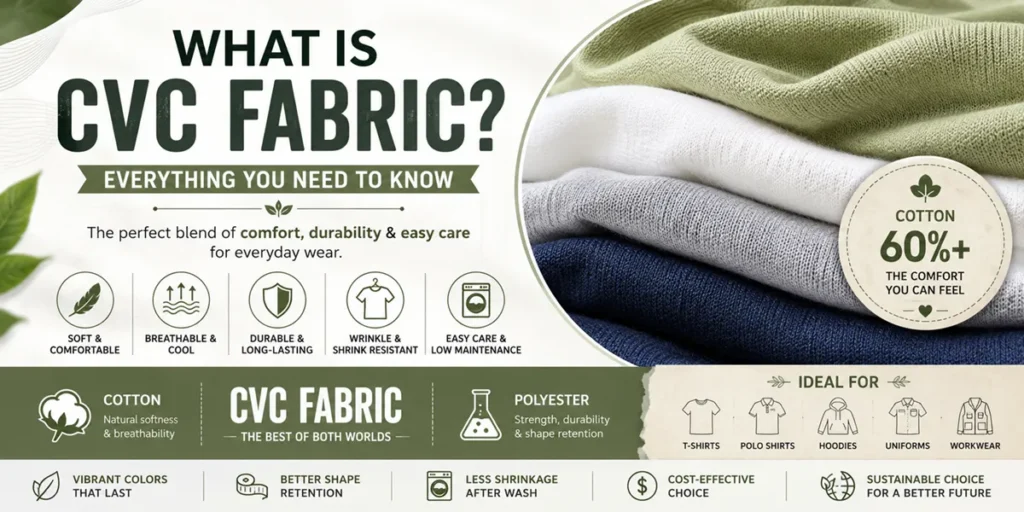
In the textile and apparel industry, selecting the right fabric is one of the most important factors in creating high-quality garments. Among the many fabric options available, CVC fabric has become a popular choice for manufacturers and fashion brands due to its excellent balance of comfort, durability, and affordability.
But what exactly is CVC fabric, and why is it widely used in clothing production?
This comprehensive guide explains everything you need to know about CVC fabric, including its composition, properties, advantages, disadvantages, common applications, and how it compares with other popular fabrics like TC and 100% cotton.
What is CVC Fabric?
CVC fabric stands for Chief Value Cotton, a blended fabric made from cotton and polyester, where cotton is the dominant fiber.
Typically, CVC fabrics contain:
- 60% Cotton / 40% Polyester
- 65% Cotton / 35% Polyester
- 70% Cotton / 30% Polyester
- 80% Cotton / 20% Polyester
As long as the cotton content exceeds 50%, the fabric is generally classified as CVC.
The higher cotton ratio gives CVC fabric the softness and breathability of natural fibers while retaining the durability and wrinkle resistance of polyester.
What Does “Chief Value Cotton” Mean?
The term Chief Value Cotton (CVC) indicates that cotton is the primary fiber in the fabric blend.
Compared to pure cotton, CVC fabric offers improved durability and easier maintenance. Compared to polyester-rich fabrics, it provides better comfort and moisture absorption.
This balance makes CVC one of the most practical fabrics for everyday apparel.
How is CVC Fabric Made?
The manufacturing process generally includes the following steps:
- Cotton and polyester fibers are blended in specific proportions.
- The blended fibers are spun into yarn.
- The yarn is knitted or woven into fabric.
- The fabric undergoes dyeing and finishing treatments.
- Additional processes such as anti-pilling, enzyme washing, or softening may be applied depending on the desired performance.
Modern textile mills use advanced blending technologies to ensure consistent fabric quality and color uniformity.
Key Characteristics of CVC Fabric
CVC fabric combines the strengths of both cotton and polyester.
Soft and Comfortable
Thanks to its high cotton content, CVC fabric feels soft against the skin and provides excellent wearing comfort.
Good Breathability
Cotton fibers allow air to circulate more effectively than synthetic fabrics, helping wearers stay cool throughout the day.
Excellent Durability
The polyester component increases tensile strength, making garments more resistant to tearing and frequent washing.
Wrinkle Resistance
Unlike 100% cotton, CVC fabric wrinkles less and maintains a neat appearance with minimal ironing.
Reduced Shrinkage
Polyester helps stabilize the fabric structure, significantly reducing shrinkage after washing.
Better Shape Retention
Garments made from CVC fabric are less likely to lose their original shape over time.
Advantages of CVC Fabric
1. Superior Comfort
The high cotton percentage makes CVC fabric pleasant to wear, even for extended periods.
2. Longer Garment Lifespan
The polyester blend improves abrasion resistance, making clothing last longer.
3. Easy Care
CVC garments are easier to wash, dry quickly, and require less ironing.
4. Cost-Effective
Compared with 100% cotton fabrics, CVC often provides similar comfort at a more competitive price.
5. Good Color Retention
CVC fabric generally holds dye well, helping garments maintain vibrant colors after repeated washes.
6. Less Pilling Than Polyester-Rich Fabrics
The higher cotton content reduces the likelihood of excessive pilling.
Disadvantages of CVC Fabric
Despite its many benefits, CVC fabric also has some limitations.
Not as Breathable as 100% Cotton
Although breathable, polyester slightly reduces airflow compared to pure cotton.
Contains Synthetic Fiber
Some consumers who prefer entirely natural fabrics may still favor 100% cotton.
Limited Heat Resistance
Like other polyester blends, excessive heat during ironing can damage the fabric.
Common Uses of CVC Fabric
Because of its versatility, CVC fabric is widely used in many apparel categories.
T-Shirts
CVC is one of the most popular fabrics for premium T-shirts because it offers softness while maintaining shape.
Polo Shirts
Its wrinkle resistance and durability make it ideal for corporate uniforms and casual polos.
Hoodies and Sweatshirts
The fabric provides warmth, comfort, and durability for everyday wear.
School Uniforms
CVC withstands frequent washing while remaining comfortable for students.
Workwear
Many companies choose CVC for uniforms due to its balance of comfort and durability.
Sports Casual Wear
Although not designed for high-performance athletics, CVC performs well in everyday activewear.