
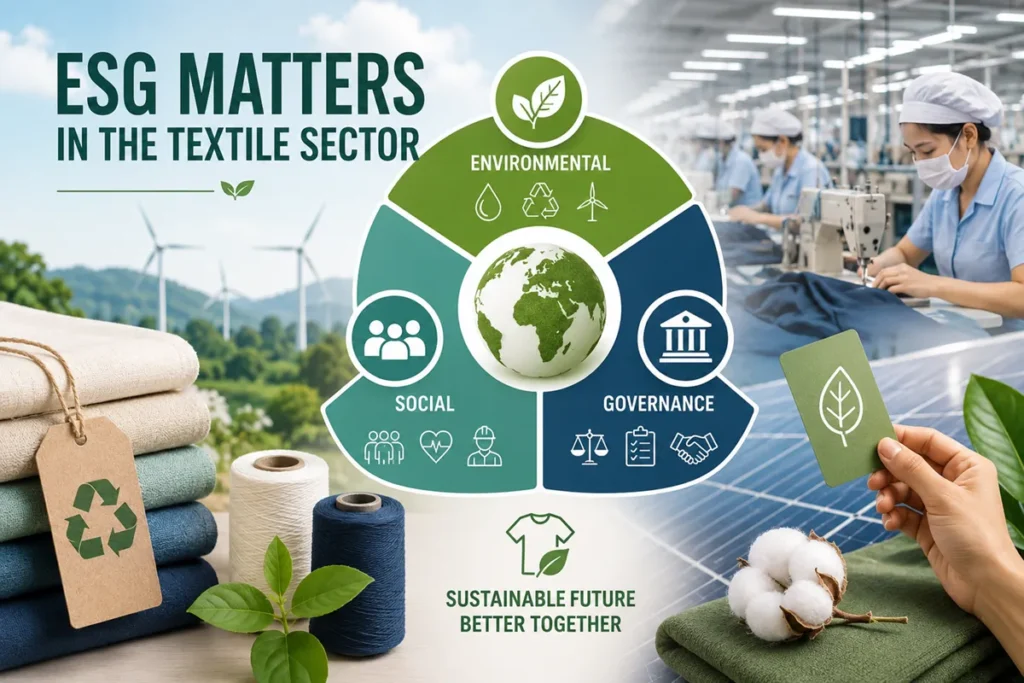
As sustainability becomes a top priority for consumers, governments, and global brands, Environmental, Social, and Governance (ESG) principles are reshaping the textile and apparel industry. Once viewed as an optional corporate initiative, ESG has now become a critical factor in supplier selection, investment decisions, regulatory compliance, and long-term business success.
For textile manufacturers and apparel exporters, embracing ESG is no longer just about improving brand reputation—it is about remaining competitive in an increasingly demanding global marketplace.
What Is ESG?
ESG stands for Environmental, Social, and Governance, a framework used to evaluate how responsibly a company operates beyond its financial performance.
- Environmental focuses on reducing environmental impacts such as carbon emissions, water consumption, chemical management, waste reduction, and energy efficiency.
- Social emphasizes employee welfare, fair labor practices, workplace safety, diversity, community engagement, and human rights.
- Governance relates to ethical business practices, transparency, compliance, risk management, and corporate accountability.
Together, these three pillars help companies build sustainable operations while meeting the expectations of customers, investors, and regulators.
Why ESG Is Becoming Essential in the Textile Industry
The textile sector is one of the world’s largest manufacturing industries, but it is also among the most resource-intensive. From cotton cultivation and dyeing processes to garment production and logistics, the supply chain consumes significant amounts of water, energy, and raw materials.
As environmental concerns continue to grow, governments and international brands are demanding greater transparency across the supply chain. ESG provides the framework for manufacturers to demonstrate responsible production and continuous improvement.
Companies that proactively adopt ESG practices are better positioned to secure long-term partnerships with global fashion brands.
Environmental Responsibility: Reducing the Industry’s Footprint
Environmental performance has become one of the most closely monitored aspects of textile manufacturing.
Key environmental initiatives include:
- Reducing greenhouse gas emissions
- Improving energy efficiency
- Investing in renewable energy
- Conserving water resources
- Implementing wastewater treatment systems
- Using sustainable fibers and recycled materials
- Minimizing textile waste through circular production
Many leading apparel brands have established ambitious climate goals, requiring suppliers to contribute toward carbon reduction throughout the value chain.
Factories with strong environmental management systems are increasingly preferred by international buyers seeking to reduce their Scope 3 emissions.
Social Responsibility Creates Stronger Supply Chains
People remain the foundation of every successful textile business.
Social responsibility extends far beyond legal compliance. It includes creating safe working environments, providing fair wages, respecting labor rights, supporting employee development, and ensuring equal opportunities for all workers.
Brands today carefully evaluate suppliers based on labor standards because poor working conditions can severely damage brand reputation.
Strong social performance leads to:
- Higher employee retention
- Improved productivity
- Better product quality
- Reduced operational risks
- Increased customer confidence
Ultimately, investing in people creates a more resilient and reliable manufacturing operation.
Good Governance Builds Trust
Governance may receive less public attention than environmental initiatives, but it is equally important.
Effective governance includes:
- Transparent reporting
- Ethical sourcing policies
- Anti-corruption measures
- Regulatory compliance
- Strong internal controls
- Responsible leadership
International buyers increasingly require suppliers to provide ESG reports, certifications, and traceability documentation. Companies with robust governance systems can respond more efficiently to audits and compliance requirements.
Trust has become a valuable competitive advantage in today’s global sourcing environment.
ESG Is Influencing Buying Decisions
Global fashion retailers are integrating ESG criteria directly into supplier evaluation processes.
Buyers now consider factors such as:
- Carbon footprint
- Renewable energy usage
- Water management
- Worker welfare
- Supply chain transparency
- Ethical sourcing
- ESG reporting capabilities
Suppliers that fail to meet these expectations may lose business opportunities, while those with strong ESG performance gain preferred supplier status and long-term contracts.
In many cases, ESG performance has become just as important as price, quality, and delivery.
ESG Helps Reduce Business Risks
Implementing ESG practices also strengthens operational resilience.
Companies with effective ESG strategies are generally better prepared for:
- New environmental regulations
- Supply chain disruptions
- Climate-related risks
- Labor shortages
- Investor expectations
- Customer compliance audits
Rather than reacting to changing regulations, ESG-focused businesses can adapt more quickly and maintain stable operations.
The Competitive Advantage for Vietnamese Textile Manufacturers
Vietnam has become one of the world’s leading apparel sourcing destinations thanks to its skilled workforce, competitive manufacturing capabilities, and participation in multiple free trade agreements.
To maintain this momentum, Vietnamese textile manufacturers are increasingly investing in sustainable production technologies, green factories, digital traceability systems, and internationally recognized certifications.
By integrating ESG into their business strategies, Vietnamese suppliers can strengthen relationships with global brands while enhancing their reputation in international markets.
How Textile Companies Can Begin Their ESG Journey
Implementing ESG does not happen overnight, but companies can begin with practical improvements:
- Measure energy and water consumption
- Set carbon reduction targets
- Improve waste management
- Enhance worker training and safety programs
- Adopt transparent governance policies
- Obtain internationally recognized sustainability certifications
- Invest in digital traceability solutions
- Publish annual sustainability reports
Small, continuous improvements often lead to significant long-term benefits.
Conclusion
ESG is transforming the future of the textile industry. It is no longer simply a sustainability initiative—it has become a strategic business requirement that influences purchasing decisions, investment opportunities, regulatory compliance, and long-term growth.
For textile manufacturers, particularly those serving international markets, embracing ESG means building stronger customer relationships, reducing operational risks, improving efficiency, and creating lasting value.
As global demand for sustainable sourcing continues to rise, companies that prioritize Environmental, Social, and Governance principles will be better equipped to lead the next generation of responsible textile manufacturing.