
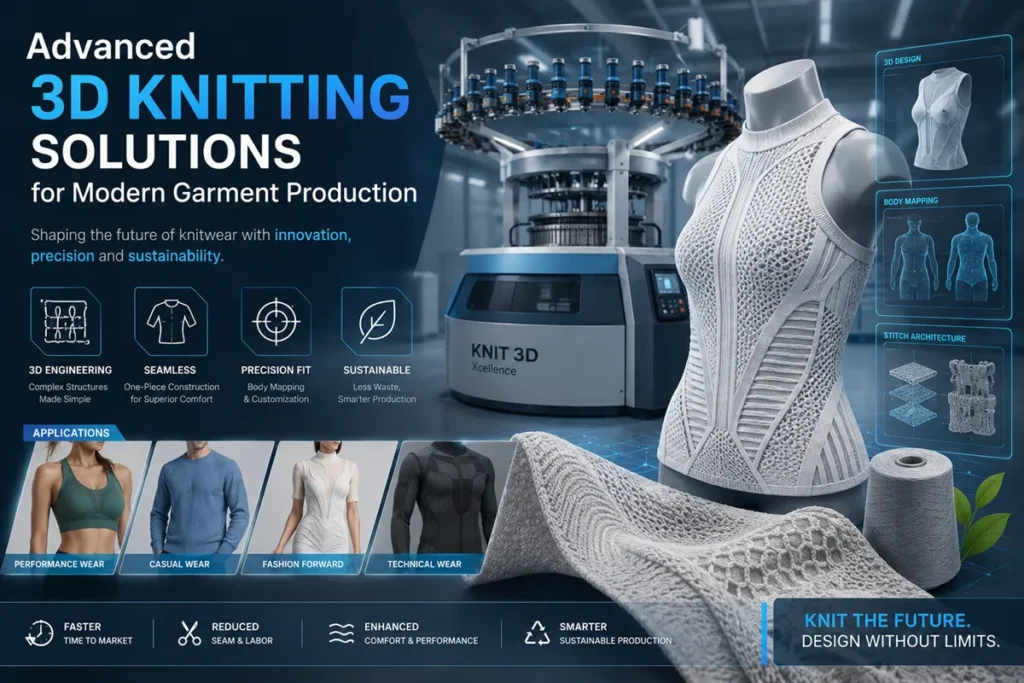
The global apparel industry is rapidly evolving, driven by technological innovation, sustainability goals, and increasing consumer demand for high-quality, customized products. Among the most groundbreaking advancements is 3D knitting technology, a manufacturing process that is transforming how garments are designed, produced, and delivered. By integrating digital engineering with automated knitting systems, 3D knitting enables manufacturers to produce seamless garments with exceptional precision while significantly reducing waste and production costs.
In today’s competitive fashion and textile market, 3D knitting has become a strategic solution for brands seeking greater efficiency, flexibility, and environmental responsibility.
What Is 3D Knitting Technology?
3D knitting, also known as whole garment knitting or seamless knitting, is an advanced manufacturing process that creates an entire garment directly on a computerized knitting machine without requiring multiple fabric panels to be cut and sewn together.
Unlike conventional garment manufacturing, which involves numerous production stages—including fabric production, cutting, sewing, and finishing—3D knitting integrates these processes into a single automated workflow. The result is a finished product that requires minimal post-production while maintaining exceptional consistency and quality.
Advanced software allows designers to create digital garment models, which are then translated directly into machine instructions. This digital workflow enables rapid prototyping, precise customization, and efficient production with minimal material waste.
How 3D Knitting Works
The 3D knitting process typically includes the following steps:
- Digital Garment Design
- Designers create a virtual garment using specialized CAD software.
- Yarn types, stitch structures, textures, and garment dimensions are programmed digitally.
- Machine Programming
- The digital design is transferred directly to computerized flat knitting machines.
- Production parameters are automatically optimized for accuracy.
- Automated Knitting
- The machine knits the complete garment in one continuous process.
- Sleeves, collars, pockets, and body panels can all be integrated seamlessly.
- Minimal Finishing
- Since the garment is produced nearly complete, only minor finishing tasks such as washing, pressing, labeling, or quality inspection are required.
Key Advantages of 3D Knitting Technology
1. Reduced Material Waste
Traditional cut-and-sew manufacturing often generates significant fabric waste during cutting. In contrast, 3D knitting uses yarn only where needed, dramatically reducing material consumption.
This contributes to:
- Lower production costs
- Improved resource efficiency
- Reduced environmental impact
- More sustainable manufacturing practices
2. Seamless Comfort
Because garments are knitted as one continuous piece, uncomfortable seams are eliminated.
Benefits include:
- Better fit
- Enhanced flexibility
- Improved freedom of movement
- Increased wearer comfort
This makes 3D knitting especially suitable for:
- Sportswear
- Activewear
- Performance apparel
- Compression garments
- Medical textiles
3. Faster Product Development
Digital workflows allow manufacturers to quickly modify designs and produce samples within hours instead of weeks.
Advantages include:
- Shorter lead times
- Rapid prototyping
- Faster product launches
- Improved responsiveness to fashion trends
4. Mass Customization
One of the greatest strengths of 3D knitting is its ability to produce customized garments without major production disruptions.
Manufacturers can easily adjust:
- Size
- Color
- Stitch pattern
- Compression zones
- Branding elements
This flexibility supports personalized fashion and made-to-order production models.
5. Lower Labor Requirements
Traditional garment manufacturing relies heavily on manual sewing operations.
3D knitting automates much of the production process, resulting in:
- Reduced labor costs
- Higher productivity
- Consistent quality
- Lower risk of production errors
Sustainability Benefits
Sustainability has become a major priority for global fashion brands, and 3D knitting aligns perfectly with modern environmental objectives.
Environmental advantages include:
- Reduced textile waste
- Lower energy consumption
- Fewer production stages
- Reduced transportation between manufacturing processes
- Lower carbon emissions
- Efficient use of raw materials
Many leading apparel brands are adopting 3D knitting as part of their commitment to circular fashion and responsible manufacturing.
Applications Across the Apparel Industry
3D knitting technology is widely used across multiple apparel sectors, including:
Sportswear
Athletic garments benefit from lightweight construction, moisture management, stretch performance, and seamless comfort.
Fashion Knitwear
Premium sweaters, cardigans, dresses, and knit tops can be produced with intricate patterns and superior finishing.
Footwear Uppers
Many athletic shoe manufacturers utilize 3D knitted uppers for improved flexibility, breathability, and reduced weight.
Medical Textiles
Compression garments, orthopedic supports, and rehabilitation wear require precise fit and targeted compression zones that 3D knitting can achieve effectively.
Workwear
Durable, functional work garments with reinforced areas can be produced efficiently while maintaining wearer comfort.
Challenges of 3D Knitting Technology
Despite its numerous advantages, implementing 3D knitting presents several challenges.
High Initial Investment
Computerized knitting machines require significant capital investment, making adoption more difficult for smaller manufacturers.
Skilled Workforce
Successful implementation requires experienced technicians capable of operating advanced machinery and programming digital knitting designs.
Limited Material Compatibility
Although yarn options continue to expand, not every fiber is currently suitable for advanced 3D knitting applications.
The Future of 3D Knitting
The future of apparel manufacturing is increasingly digital, automated, and sustainable.
Emerging technologies such as Artificial Intelligence (AI), Internet of Things (IoT), digital twins, and smart manufacturing systems are expected to further enhance 3D knitting capabilities.
Future developments may include:
- AI-assisted garment design
- Fully automated production lines
- On-demand manufacturing
- Smart wearable textiles
- Digital inventory systems
- Hyper-personalized apparel production
As consumers demand faster delivery, greater personalization, and environmentally responsible products, 3D knitting is positioned to become a core technology in next-generation apparel manufacturing.
Conclusion
3D knitting technology represents a major leap forward in modern apparel manufacturing. By combining automation, digital design, sustainability, and precision engineering, it enables manufacturers to produce high-quality garments with minimal waste and shorter production cycles.
For apparel brands, exporters, and textile manufacturers seeking to improve efficiency while meeting global sustainability standards, investing in 3D knitting technology is no longer simply an innovation—it is becoming a competitive necessity. As the fashion industry continues its digital transformation, 3D knitting will play a central role in shaping the future of garment production worldwide.