
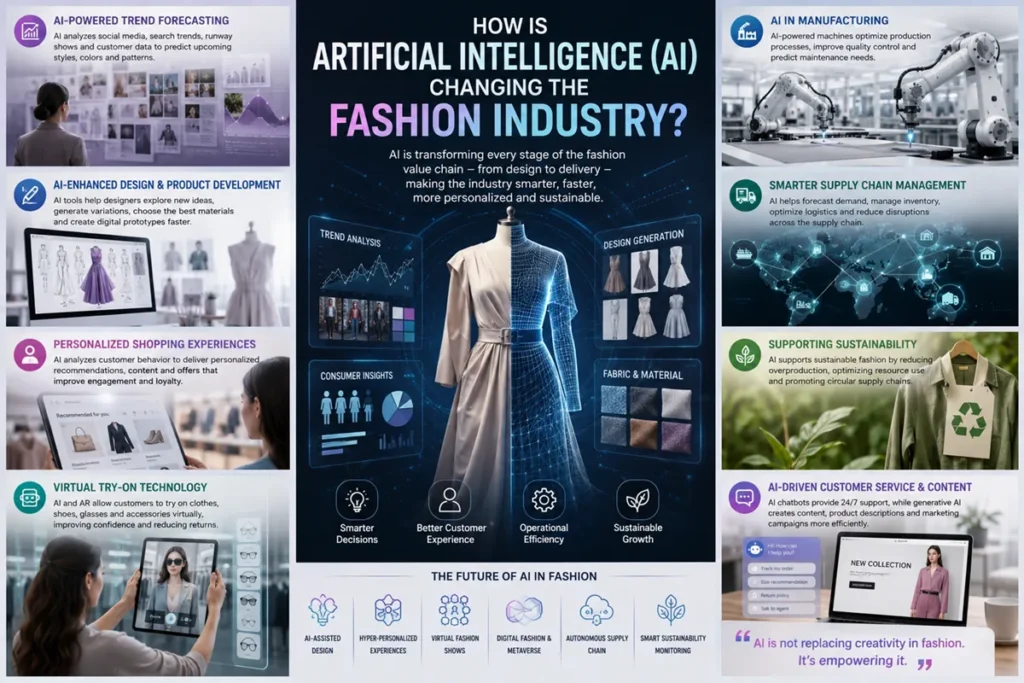
Artificial intelligence (AI) is rapidly transforming industries worldwide, and the fashion sector is no exception. From trend forecasting and product design to inventory management and personalized shopping experiences, AI is revolutionizing the way fashion brands operate. As consumer expectations continue to evolve and sustainability becomes a growing concern, fashion companies are increasingly turning to AI-driven solutions to improve efficiency, enhance creativity, and remain competitive in a fast-changing market.
In this article, we explore how artificial intelligence is changing the fashion industry and what the future may hold for brands, manufacturers, and consumers.
The Growing Role of AI in Fashion
The global fashion industry has traditionally relied on human creativity, intuition, and experience. However, AI technologies now provide data-driven insights that enable businesses to make smarter decisions. By analyzing vast amounts of information from social media, online searches, customer behavior, and sales data, AI helps fashion companies better understand market trends and consumer preferences.
As a result, brands can reduce risks, optimize production, and deliver products that align more closely with customer demand.
AI-Powered Fashion Trend Forecasting
One of the most significant applications of AI in fashion is trend forecasting. Predicting upcoming fashion trends has always been challenging due to rapidly changing consumer tastes and global influences.
AI systems can analyze millions of online images, social media posts, influencer content, runway collections, and search trends in real time. These insights help brands identify emerging styles, colors, fabrics, and patterns before they become mainstream.
Benefits of AI Trend Forecasting
- Faster identification of market trends
- Reduced dependence on manual research
- Improved product planning
- Lower risk of unsold inventory
- Enhanced responsiveness to consumer demand
By making trend predictions more accurate, AI helps fashion companies stay ahead of competitors and launch collections that resonate with customers.
Transforming Fashion Design and Product Development
AI is increasingly becoming a valuable tool for designers. Rather than replacing creativity, AI enhances the design process by providing inspiration and generating new ideas.
AI-powered design software can:
- Suggest color combinations
- Create garment variations
- Generate digital prototypes
- Analyze historical fashion data
- Recommend materials and fabric choices
Designers can use these insights to accelerate product development while maintaining creative control. Some brands are even experimenting with generative AI to create entirely new fashion concepts and virtual collections.
Personalized Shopping Experiences
Modern consumers expect highly personalized shopping experiences, and AI makes this possible at scale.
AI algorithms analyze customer preferences, browsing history, purchase behavior, and demographic information to provide personalized recommendations. This level of customization helps shoppers discover products that match their interests and increases customer satisfaction.
Examples of AI Personalization
- Product recommendation engines
- Personalized marketing campaigns
- Virtual shopping assistants
- Dynamic website content
- Customized promotions and discounts
By delivering more relevant experiences, brands can increase engagement, conversion rates, and customer loyalty.
Virtual Try-On Technology
One of the most exciting developments in fashion retail is AI-powered virtual try-on technology.
Using computer vision and augmented reality (AR), shoppers can see how clothing, eyewear, shoes, or accessories may look on them before making a purchase. This technology reduces uncertainty and improves online shopping confidence.
Benefits of Virtual Try-On Solutions
- Better customer experience
- Reduced return rates
- Increased online sales
- Greater shopping convenience
- Improved product visualization
As e-commerce continues to grow, virtual fitting rooms are becoming a valuable competitive advantage for fashion retailers.
AI in Fashion Manufacturing
AI is also improving efficiency throughout the manufacturing process.
Smart production systems use AI to optimize workflows, predict equipment maintenance needs, and improve quality control. Manufacturers can identify defects more accurately and reduce production errors.
Manufacturing Advantages
- Faster production cycles
- Improved quality assurance
- Reduced waste
- Lower operational costs
- Better resource allocation
These efficiencies help fashion manufacturers increase productivity while maintaining high product standards.
Enhancing Supply Chain Management
Fashion supply chains are often complex and vulnerable to disruptions. AI helps companies gain greater visibility and control over their operations.
AI-driven supply chain management can:
- Forecast demand more accurately
- Optimize inventory levels
- Identify supply chain risks
- Improve logistics planning
- Reduce overproduction
By aligning production with actual consumer demand, brands can minimize excess inventory and improve profitability.
Supporting Sustainability Initiatives
Sustainability has become a top priority for fashion companies, and AI is playing an important role in achieving environmental goals.
The fashion industry faces criticism for issues such as waste generation, excessive water consumption, and overproduction. AI can help address these challenges by enabling smarter decision-making.
AI Applications for Sustainable Fashion
- Demand forecasting to reduce overproduction
- Material optimization to minimize waste
- Energy-efficient manufacturing processes
- Supply chain transparency
- Recycling and circular fashion initiatives
By improving resource efficiency, AI contributes to more sustainable and responsible fashion practices.
AI-Driven Customer Service
Customer service is another area where AI is creating significant value.
AI-powered chatbots and virtual assistants can handle common customer inquiries 24/7, providing instant support for:
- Product information
- Order tracking
- Size recommendations
- Return policies
- Shopping assistance
These tools improve customer satisfaction while reducing operational costs for retailers.
The Rise of AI-Generated Fashion Content
Marketing teams are increasingly using AI to create content for fashion campaigns.
Generative AI can assist with:
- Product descriptions
- Social media content
- Advertising copy
- Visual concepts
- Marketing personalization
This allows brands to produce content more efficiently while maintaining consistent messaging across multiple channels.
Challenges and Ethical Considerations
Despite its many benefits, AI adoption in fashion also presents challenges.
Key Concerns
Data Privacy
AI systems rely heavily on customer data, raising concerns about privacy and data protection.
Bias in Algorithms
Poorly trained AI models may produce biased recommendations or exclude certain customer groups.
Workforce Impact
Automation may alter job roles within design, retail, and manufacturing sectors.
Intellectual Property Issues
The use of generative AI in design raises questions about ownership and originality.
Fashion companies must implement responsible AI practices to ensure transparency, fairness, and ethical use of technology.
The Future of AI in Fashion
The influence of AI on the fashion industry is expected to grow significantly in the coming years. Future innovations may include:
- Fully AI-assisted design workflows
- Hyper-personalized shopping experiences
- Advanced virtual fashion shows
- Digital clothing for virtual environments
- Autonomous supply chain optimization
- Smart sustainability monitoring systems
As technology continues to evolve, AI will become an increasingly important driver of innovation, efficiency, and customer engagement throughout the fashion ecosystem.
Conclusion
Artificial intelligence is reshaping every stage of the fashion value chain, from design and manufacturing to marketing and customer service. By enabling better forecasting, personalized experiences, improved operational efficiency, and more sustainable practices, AI is helping fashion brands adapt to changing consumer demands and market conditions.
While challenges related to ethics, privacy, and workforce transformation remain, the potential benefits of AI are undeniable. Companies that successfully integrate AI into their operations will be better positioned to innovate, compete, and thrive in the future of fashion.
As the industry embraces digital transformation, artificial intelligence is no longer just a technological trend—it is becoming a fundamental part of the fashion industry’s future.