
Waterless dyeing is rapidly gaining recognition as a breakthrough solution for environmentally responsible textile production. As fashion and apparel manufacturers face growing demands to reduce water usage, wastewater generation, and greenhouse gas emissions, innovative dyeing technologies that operate with little or no water are becoming increasingly valuable. From supercritical carbon dioxide systems to foam-based applications and digital coloration methods, these advancements are redefining textile coloration by lowering environmental impacts while improving manufacturing performance. Discover how water-free dyeing technologies are shaping the future of sustainable textiles with Vishimex.
The Environmental Challenge of Conventional Textile Dyeing
The textile sector is among the world’s largest industrial consumers of freshwater, particularly during coloration and finishing operations. Traditional dyeing methods generally require between 100 and 200 liters of water for every kilogram of fabric processed, including preparation, coloring, washing, and rinsing stages. A significant portion of this water becomes contaminated with dyes, salts, and processing chemicals, creating major wastewater treatment challenges. Industry studies estimate that textile dyeing and finishing contribute approximately 20% of global industrial water pollution.
As a leading exporter of garments and textiles, Vietnam faces unique sustainability pressures. While the industry plays a vital role in economic growth and export earnings, it also places substantial demands on freshwater supplies and wastewater treatment infrastructure. Concentrated dyeing operations within industrial zones have raised concerns regarding water quality in several river systems. Consequently, adopting low-water and water-free coloration technologies has become increasingly important for maintaining international competitiveness and meeting the sustainability expectations of global buyers.
Water-free textile coloration refers to processes that either eliminate water entirely or drastically reduce its role as the medium used to transfer color onto fabrics. Instead of relying on aqueous dye baths, these methods utilize alternative carriers such as supercritical fluids, air, or foam. This article explores the major technologies, technical capabilities, benefits, limitations, and potential applications within key textile-producing countries, including Vietnam.
Fundamental Concepts Behind Waterless Dyeing
Unlike conventional dyeing systems that depend on water-based solutions, waterless technologies employ alternative mechanisms to deliver color into textile fibers. The most established approach uses supercritical carbon dioxide (SC-CO₂) as the transport medium. When carbon dioxide is exposed to temperatures and pressures above its critical point, it exhibits characteristics of both liquids and gases, enabling dye molecules to penetrate synthetic fibers efficiently, especially polyester.
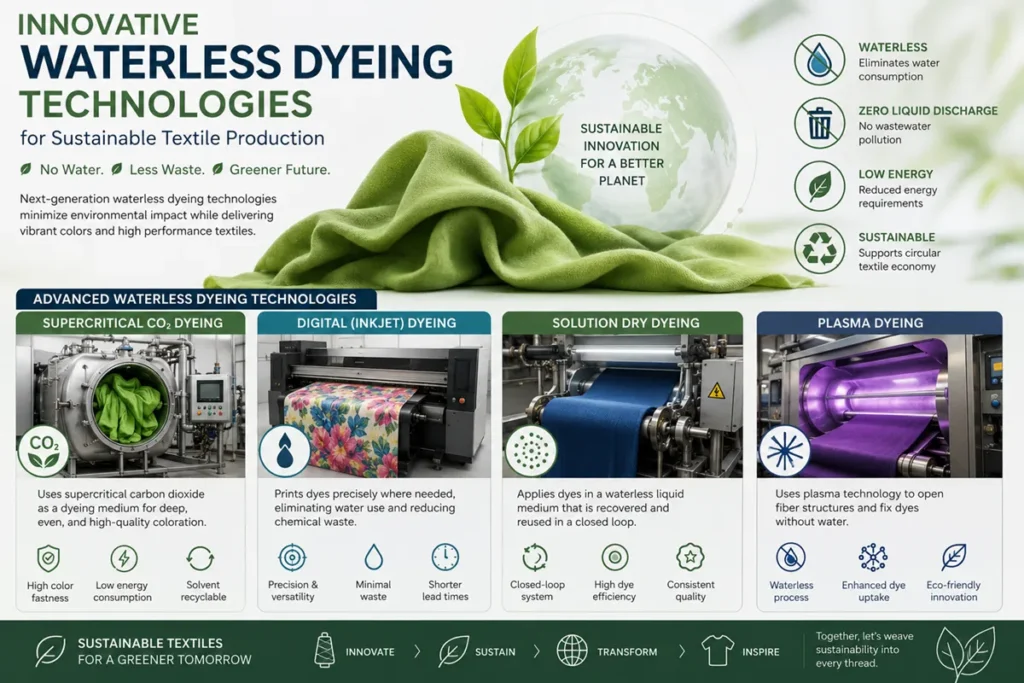
Additional approaches include air-assisted coloration systems and foam-based applications, which significantly reduce water requirements even if they do not eliminate water completely. Another related method is dope dyeing, also known as mass coloration, where pigments are added directly into the polymer before fibers are extruded. Although highly efficient, this technique is limited to fiber production rather than dyeing finished fabrics.
Supercritical Carbon Dioxide Dyeing
Among available technologies, supercritical carbon dioxide dyeing is considered the most advanced true zero-water solution. In this process, carbon dioxide is pressurized and heated until it reaches a supercritical state. The CO₂ then dissolves disperse dyes and transports them deep into synthetic fibers. Once coloration is complete, pressure is reduced and the carbon dioxide returns to its gaseous form, allowing most of it to be recovered and reused within a closed-loop system.
This technology offers several significant advantages. Wastewater generation is eliminated, energy consumption is reduced because extensive drying is unnecessary, and excellent color consistency and durability can be achieved on polyester materials. Independent studies have reported greenhouse gas reductions of up to 58% compared with conventional dyeing operations.
Despite these benefits, challenges remain. SC-CO₂ systems are most effective for synthetic fibers and specific dye classes. Natural fibers such as cotton remain difficult to process because of differences in fiber chemistry and polarity. In addition, the specialized equipment required for high-pressure operation involves substantial upfront investment, which can limit widespread adoption.
Digital Printing and Foam-Based Coloration
Digital textile printing represents another important low-water alternative. Rather than immersing fabric in large dye baths, digital printers apply color directly onto the textile surface with high precision. This approach significantly lowers water and chemical consumption while offering excellent design flexibility.
Foam application technology replaces much of the liquid traditionally used in dyeing with a foam carrier. By delivering dyes through foam rather than large volumes of water, manufacturers can reduce water consumption by as much as 80% while maintaining compatibility with a broader range of fabrics. Although neither method achieves complete water elimination, both substantially decrease resource consumption and production waste.
Plasma-Assisted Textile Processing
Plasma technology provides another promising direction for sustainable coloration. Using ionized gases, plasma treatment alters textile surfaces at the microscopic level, improving dye absorption without requiring conventional wet pre-treatments or large quantities of chemicals. While still largely in the research and pilot-commercialization phase, plasma-assisted processing offers potential for highly efficient dry finishing and coloration across multiple fiber categories. Ongoing development focuses on improving scalability and reducing operating costs.
Environmental and Economic Advantages
The most obvious environmental benefit of water-free dyeing technologies is the conservation of freshwater resources. By minimizing or eliminating water use during coloration, these systems help reduce both resource depletion and wastewater treatment burdens. Additional sustainability benefits include lower energy consumption, reduced chemical usage, and smaller carbon footprints.
For Vietnam’s textile sector, integrating these technologies could support compliance with increasingly strict environmental standards imposed by international brands and retailers. Given the country’s strong position in global apparel supply chains, sustainable dyeing solutions may become an important competitive advantage, particularly for polyester-based production.
Although the initial investment for advanced equipment can be significant, long-term savings from reduced water procurement, wastewater treatment, and energy use may improve overall economic performance. Improved color consistency and lower defect rates further contribute to operational efficiency.
Applications in Vietnam and International Markets
Although adoption remains uneven across the global textile industry, several commercial examples demonstrate that these technologies are moving beyond laboratory development. One of the most prominent examples is SC-CO₂ dyeing for polyester fabrics and yarns. A well-known Dutch technology provider has successfully commercialized closed-loop carbon dioxide dyeing systems that use reclaimed CO₂ rather than water. These systems achieve true zero-water processing while recycling most of the carbon dioxide used during production.
The relevance of such technologies is particularly high in Asia, where textile and garment manufacturing remains concentrated. Countries including Vietnam, China, Bangladesh, India, Thailand, and Indonesia face increasing pressure to balance production costs with environmental responsibility. For Vietnamese manufacturers producing polyester sportswear, performance apparel, technical textiles, and synthetic-blend products, SC-CO₂ systems could provide a strategic advantage in selected market segments.
However, realistic expectations are important. Waterless technologies are unlikely to replace traditional dyeing across the entire industry in the near future. Their greatest potential currently lies within higher-value export sectors where buyers prioritize environmental performance, traceability, and resource efficiency. Manufacturers serving premium sportswear, workwear, technical textiles, recycled polyester products, and sustainability-focused fashion brands may benefit most from early adoption.
Foam-based systems offer a more accessible alternative for companies unable to invest immediately in high-pressure CO₂ equipment. These technologies significantly reduce water requirements while remaining compatible with existing production processes. Hundreds of industrial installations worldwide suggest that foam application may provide a practical transition pathway toward cleaner textile manufacturing.
Denim production represents another promising area. Conventional indigo dyeing relies on repeated dipping, oxidation, washing, and chemical-intensive processing. Foam-assisted indigo application has attracted industry interest as a means of reducing water consumption, chemical inputs, and processing time. Although further commercial validation is needed, these developments illustrate how low-water technologies can be adapted to specific product categories.
From a market perspective, sustainable coloration methods also enhance export competitiveness. Increasingly, international buyers evaluate suppliers not only on cost and delivery performance but also on environmental compliance, chemical management, carbon reduction, and wastewater control. Technologies such as SC-CO₂ systems, foam application, digital printing, and low-liquor-ratio processes can support compliance with frameworks including OEKO-TEX, bluesign, ZDHC, and REACH-related requirements.
While technology alone does not guarantee certification, it can help manufacturers establish cleaner, more transparent, and more traceable production systems. As a result, suppliers demonstrating measurable reductions in water use, wastewater generation, and chemical consumption may enjoy stronger positioning when competing for business from brands in Europe, North America, Japan, and South Korea.
Obstacles to Wider Adoption
Despite its sustainability advantages, water-free textile coloration still faces several challenges.
Fiber Compatibility
One of the most significant limitations involves fiber suitability. SC-CO₂ systems perform exceptionally well with polyester because disperse dyes dissolve effectively in supercritical carbon dioxide and diffuse readily into synthetic fibers. Natural fibers such as cotton, wool, linen, and viscose present greater challenges due to their chemical properties and affinity for moisture.
This issue is particularly important in countries such as Vietnam, where cotton-rich fabrics, blended materials, and multi-fiber products are widely used. Achieving consistent coloration, durability, and fabric performance across blended textiles remains more complex than processing pure polyester.
Technical Constraints of Foam Systems
Although foam technologies substantially reduce water consumption, they require careful control of foam stability, bubble structure, dye penetration, and fabric absorption characteristics. Improper foam behavior can lead to uneven coloration or insufficient dye transfer. Research indicates that further optimization is often needed to match the performance of traditional immersion dyeing.
High Capital Requirements
Advanced SC-CO₂ equipment requires pressure-resistant vessels, recovery systems, sophisticated controls, specialized safety measures, and highly trained personnel. These factors result in considerably higher initial investment compared with conventional dyeing machinery. Large manufacturers may justify such expenditures through long-term contracts and sustainability commitments, while smaller companies often face longer payback periods.
Integration into Existing Production Systems
Dyeing is only one component of a broader textile manufacturing workflow. Facilities adopting new coloration technologies may need to redesign production processes, retrain personnel, and modify quality control procedures. Operators must become familiar with new equipment, dye systems, maintenance requirements, and process-monitoring techniques.
Supply Chain Preparedness
Successful implementation depends on access to suitable dyes, chemical formulations, machinery suppliers, technical service providers, and testing facilities. In regions where these supporting resources remain limited, manufacturers may become reliant on imported materials and foreign expertise, increasing both costs and operational complexity.
Government support can play a critical role in overcoming these barriers. Incentives such as tax benefits, green financing programs, pilot-project funding, technical training initiatives, and support for cleaner production technologies could accelerate adoption. Rather than requiring immediate industry-wide transformation, policymakers may focus on high-potential segments such as polyester textiles, sportswear, technical fabrics, and export-oriented dyeing operations.
Industrial parks can also contribute by providing shared testing facilities, certification support, wastewater monitoring services, and sustainability reporting infrastructure. Over the long term, successful implementation will depend on collaboration among brands, manufacturers, equipment suppliers, chemical companies, financial institutions, certification organizations, and government agencies.
Future Developments
The future of sustainable textile coloration is unlikely to rely on a single technology. Instead, manufacturers are expected to adopt hybrid solutions tailored to specific fibers, products, production volumes, and customer requirements.
SC-CO₂ systems may remain the preferred choice for polyester and other synthetic fibers, while foam application, digital printing, plasma treatment, dope dyeing, and low-liquor-ratio methods address different segments of the market.
Integrated systems may become increasingly common. Plasma treatment could serve as a dry surface-modification step prior to coloration, improving dye uptake and reducing chemical consumption. Digital printing may provide highly precise coloration for customized products and short production runs, while foam application offers efficient coverage for broader fabric categories. SC-CO₂ technology may continue to dominate large-scale polyester production requiring superior color depth and fastness.
Another important area of development involves dye chemistry. Expanding water-free technologies to natural fibers will require new approaches that improve dye solubility, fiber affinity, and fixation under low-water conditions. Researchers are exploring innovative dye molecules, fiber modifications, bio-based additives, and advanced pre-treatment techniques to make cotton and other cellulosic fibers more compatible with non-aqueous systems.
Achieving commercially viable solutions for cotton would represent a major milestone. As one of the world’s most widely used apparel fibers, cotton offers enormous potential for environmental improvement if waterless technologies can meet industrial requirements for color consistency, durability, fabric strength, texture, productivity, and cost efficiency.
Artificial intelligence and digital process control are also expected to play increasingly important roles. Because coloration quality depends on numerous variables—including temperature, pressure, dye concentration, fabric structure, moisture levels, and machine performance—advanced monitoring and optimization systems may help improve process stability and product quality.
Conclusion
Waterless dyeing technologies present a promising route toward more sustainable textile manufacturing. Supercritical carbon dioxide systems currently offer the closest approach to genuine zero-water coloration, while complementary solutions such as foam application and digital printing expand opportunities across a wider range of products and production environments.
To unlock the full benefits of these innovations, the industry must address challenges related to cost, fiber compatibility, technical expertise, and supply-chain readiness. For Vietnam and other major textile-producing nations, investing in advanced coloration technologies provides an opportunity to balance economic growth with environmental stewardship. As technology continues to mature and costs gradually decline, waterless dyeing is expected to evolve from a specialized innovation into a mainstream component of sustainable textile production.